


Grant requests from 20 impactful local organizations, totaling $200,000, were awarded through the J.W. and M.H. Straker Charitable Foundation small grant cycle.
Muskingum County Organizations with a 501 c 3 status, accredited educational institutions, and governmental entities that had a request for $15,000 or less were invited to apply. A large number of applications were received, amounting to requests that totaled more than twice the funds available for the Small Grant Cycle.
“[There is] so much need, and so many worthy requests,” stated Susan Holdren, President and Executive Director for the Straker Foundation .
Thanks to the generosity of the Straker Foundation, three fire departments were able to add vital life-saving equipment to their stations, including the Perry Township Fire Department, South Zanesville Fire Department, and Tri-Valley Joint Fire Department. Gifts of $14,970, $15,000, and $6,960 were granted, respectively. Perry Township will be purchasing rescue struts among other equipment, South Zanesville will be adding a LIFEPAK 15 cardio monitor/defibrillator to their inventory, and Tri-Valley will be adding a struts stabilization system.
Two churches, Pleasant Grove Church and Putnam Presbyterian Church, received grants. $7,797.21 will be used to repair a classroom ceiling at Pleasant Grove and technology upgrades will be able to take place at Putnam Presbyterian thanks to their grant in the amount of $3,050.
Athletic organizations, Philo Youth League Baseball and Tri-Valley Youth League Softball, were both small grant recipients, receiving $10,078.01 and $8,517.63, respectively, for field enhancements.
West Muskingum Band Boosters received $12,699 for new timpani equipment.
Zane Grey Intermediate School will be able to outfit the school library with furniture and supplies thanks to a $14,722.60 grant.
The Zanesville Civic League Community Center was awarded $2,960.71 to help launch its “Giving Corner”, a dedicated space for school supplies and hygiene products for people who come through the center.
Two new teen programs will be available as a result of a $15,000 grant provided to Big Brothers Big Sisters. One of the programs will focus on connecting Foxfire Students with local businesses to establish job shadowing opportunities within the community. The other is a mentoring program that allows area high school students to mentor littles. “So, potentially, it could be someone who was mentored before in the Lunch Buddies program, and now they’re in high school, and now they’re going to give it back and take an elementary school,” explained Holdren.
The Carr Center received $8,855 to support its Safety Town program. Safety Town teaches children around the age of four and five about safety inside and outside their homes.
Harrison Township will be able to fence in its recently renovated play area with the $13,832 it received.
New signage will be possible for both The John and Annie Glenn Museum and Muskingum County History through their respective gifts of $3,940 and $3,000. Muskingum County History will also be able to receive consultation with their remaining grant money. The John and Annie Glenn Museum will be having interstate wayfinding signage installed.
Warriors 2 Wilderness, an organization that helps veterans through outdoor therapy, received a gift of $3,748.63 for materials for outdoor structures.
Allwell Behavioral Health will be able to put $15,000 toward a truck for their C.O.R.E. programs. C.O.R.E. is a non-profit sheltered work program, that provides paid job training for Allwell clients.
The Zanesville Muskingum County Health Department (ZMCHD) was awarded $6,036.37 to support various initiatives related to outreach programs that help people experiencing homelessness or severe poverty and efforts that destigmatize needing and asking for help when living below the poverty level.
Part of the grant money will allow the ZMCHD’s Hope Givers Group to fill U Matter Bags that will be provided to people experiencing homelessness and poverty. The bags are filled with useful items like flashlights, batteries, and first aid kits, and also a few treats. The bags are distributed in February around Valentine’s Day.
The Health Department will also be expanding its Literacy for a Change program, which is open to elementary and preschools. “It’s books about going to food banks. It’s okay not to have the best shoes. It’s okay to go to thrift stores,” said Kris Headley ZMCHD Behavioral Specialist.
Community In Action (CIA) is another ZMCHD program that will benefit from the grant. “It’s getting all the community partners together that run shelters or outreaches to come together. We do now, but to encourage it to keep on going, so we can come up with solutions, as we are seeing many new people in our community having more issues with financials and seeing more people experiencing homelessness,” explained Headley. “How can we continue to fight this battle? Also, how are we going to help the people who are helping others with self-care? Because if we can’t help the people who are helping others, we’re going to have even a much harder issue in our community.”
One focal point for funding has been on food sustainability within the community. “Our little corner of the world is in better shape, probably than a major city, because people are working together to get food,” said Pam Kirst, Senior Program Director for the Foundation.
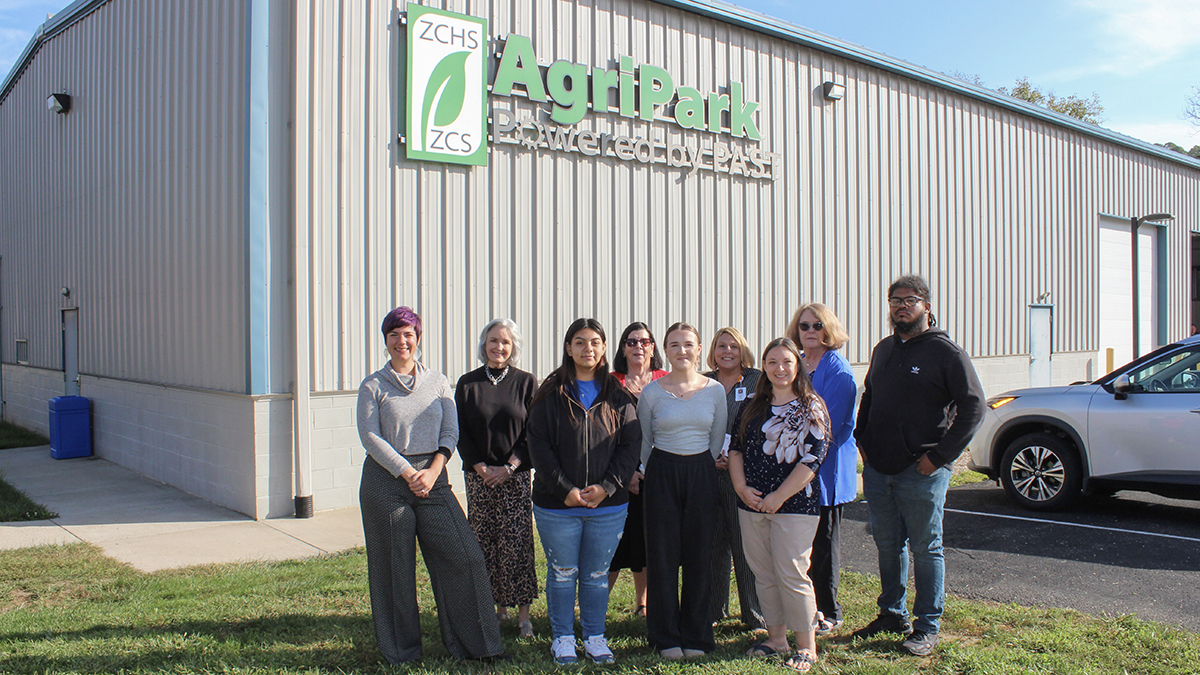
Zanesville High School received $12,500 to support the Agri-Park program, providing important materials that will help with processing what is grown by the students and will be instrumental in helping them earn their agriculture seal for graduation.
“The initiative started in 2020 just to introduce Zanesville high school kids to agriculture, to add that curriculum into our programming, and to give our kids really a hands-on opportunity to do so,” explained Zanesville High School science teacher Heather Near.
Conservation Science is taught to juniors and is focused on interaction with the environment and how to protect it. It uses a curriculum developed by the Sportsman’s Alliance. Students are taught fish identification, how to fish, how to tie knots, archery, trapping, hunting, and boating.
Introduction to Sustainable Agriculture is available to seniors. Students learn about indoor growing spaces and how to support a healthy food system.
Students from the Introduction to Sustainable Agriculture class, including seniors Tae’shaune, Josalynn, and Diana, are directly impacted by the support given to the Agri-Park by the Straker Foundation.
“This class has actually helped me help my grandmother learn about plants and whatnot because she didn’t really do too much with plants when she was younger. And she actually has a bell pepper plant because of this class,” Tae’shaune said.
“I really like doing hands-on learning. Because in the future, I want to start gardening. And this class has really helped me with that,” explained Josalynn.
Diana added, “I think this class prepares us for our future because it helps us learn more about how to prepare for the future. If you want to learn more about, you know, planting and taking care of fish or learning more about wildlife.”
A Fork Farms hydroponics pod will allow students to grow lettuce and harvest over 20 pounds a month. That lettuce will be taken to the school cafeteria or to Christ’s Table to be used to help feed those in need.
“The Straker Foundation really does a good job, a great job actually, of getting behind Zanesville City Schools, and we really appreciate their support. We’re honored to have them as a partner,” Zanesville City Schools Superintendent Laura Tompkins stated. “I think our staff does a great job of thinking outside the box and finding things that kids really want to take part in. So our students benefit from our partnerships like the Straker Foundation, but also our staff that finds what kids want to do and a pathway for them, not only today but how they can use that going forward as adults.”
Foodworks Alliance also works to help provide food for Christ’s Table, as well as TruLife Ministries and the Salvation Army through their Wastey to Tastey program. The $5,529.23 grant they received from the Straker Foundation will support that initiative.
“Wastey to Tastey is one of the projects that the Women in the Recovery with a Purpose program at FoodWorks Alliance does,” said Foodworks Alliance Executive Director Amy Aurore. “Primarily, right now, we’re getting produce from the Mid-Ohio Food Bank produce drop-offs. We also have loose agreements with Urban Greens as well. So when they have excess on occasion, they bring it to us. But it’s basically food that’s slated for as surplus or slated towards waste, and we intervene along with some other organizations, and we take that produce, we turn it into either ingredients … or we’ll turn it into a side dish.”
4,685 pounds of produce have already been processed through the program so far this year, and Aurore says they are hoping to beat 5,000 pounds by the end of the year.
Women in the Recovery with a Purpose program are involved not only in the kitchen but also in delivering the food. “It’s an opportunity for them to give back and really feel that, said Aurore. “The women try to go on the drop-offs to the places so that they get to see the excitement.”
“This particular grant is helping us to pay for all the extra things. There’s like aluminum pans, foil, and parchment paper, and all those types of things. And then specifically, they’re paying the training dollars. So that is one of the areas that is the biggest struggle for us is to get the money, because this is a workforce re-entry training program for these women in recovery. It’s not volunteer work for them. So it’s important and valuable for me to get support from our local foundation to at least pay their wages,” explained Aurore.
The Straker Foundation is always at work helping within the community, even beyond the planned grant cycle periods. “We just paid over $7,000 to process hogs that were donated from the fair,” Holdren explained. “The kids donated the hogs, and then they sent them to the processing place. … They had a box truck, a huge box truck. And it was completely full of processed hog and one steer, and so it was sausage and hamburger. And then all the food pantries who wanted to participate were there that day, and they divided it up right there in the parking lot, and we paid for the processing. It’s a great gift to get all that meat, but they wouldn’t have been able to do anything with it if they didn’t have somebody to pay for the processing, because it was not in their budget. They didn’t know this was going to happen. So we like to fill in places like that, and we’re pretty nimble. It doesn’t take us a year to evaluate a grant. And if there’s an emergency, we have helped many, many times. When something has arisen like that, I would have hated to see all that meat go to waste.”
“I think one of the defining things that we have to think about is how many people are affected. There are some great projects, but they only help two people. So it’s hard to compare that to 100 people being helped,” stated Kirst. “We’re not saying that we never help a small group, but one of the factors that we look at is how many people does this affect,” Holdren added.
The 2026 large grant cycle, which closed October 1, encompasses requests ranging from $15,000 to $150,000. Recipients will be announced later this fall. To stay informed about future grant cycles and for more information about the J.W. and M.H. Straker Charitable Foundation, please visit their website, www.strakerfoundation.org. The Straker Foundation can also be followed on both Facebook and Instagram @strakerfoundation.